
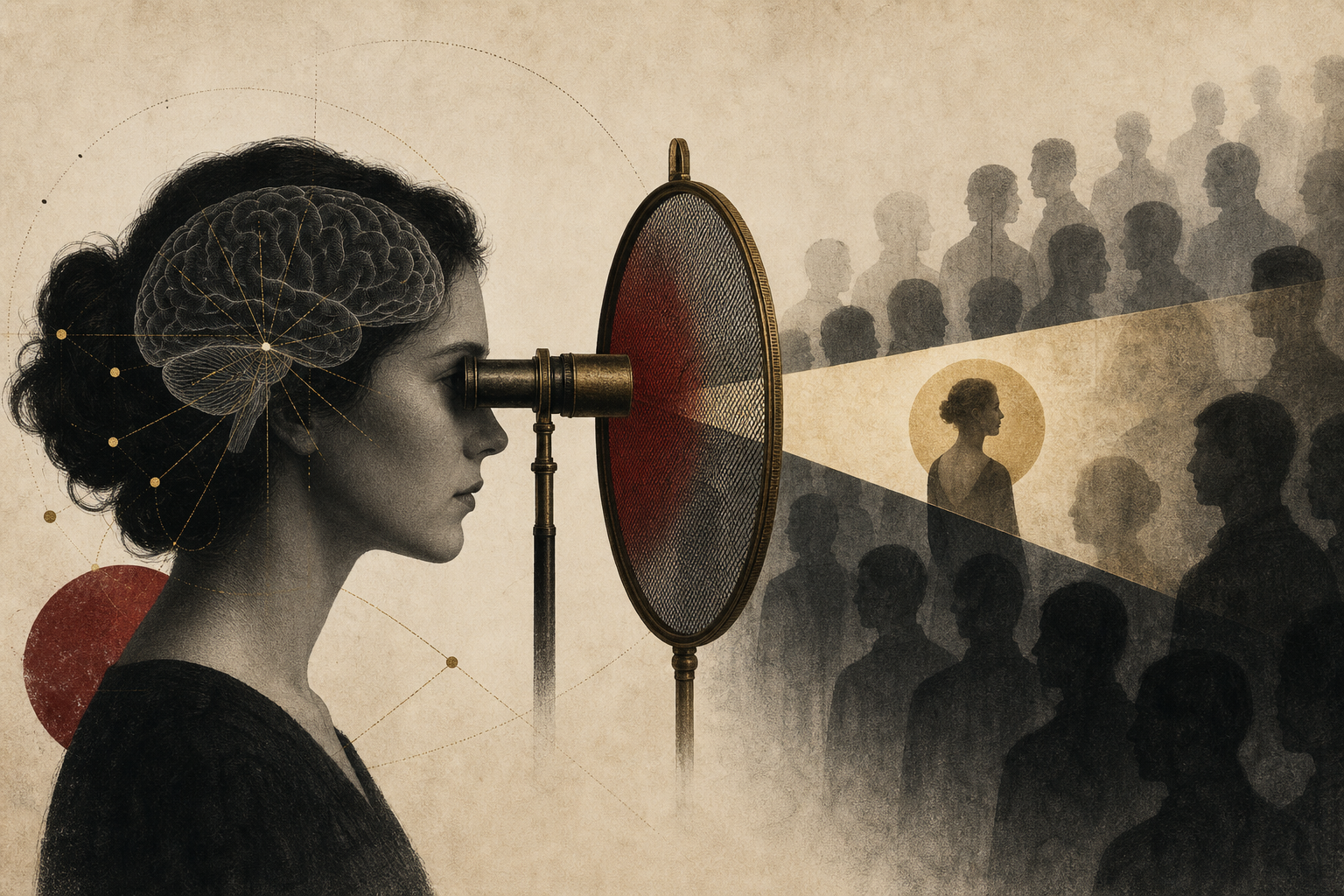
You are at a crowded party, or scrolling through a dating app on a Tuesday night. Someone's face catches your eye, or a profile stops your thumb mid-swipe. There is a sudden, visceral pull. Your heart rate changes. You feel a surge of interest that feels immediate and undeniable. In that moment, it is easy to believe you have found 'your person,' or that the lack of a spark means the other person is wrong for you. This sensation is powerful, but it is not a prophecy. It is a filter. It is a cognitive shortcut designed to save energy, not to reveal destiny.
To understand why attraction functions this way, we have to look at how the human brain processes social information. We are not rational agents who weigh every trait of a potential partner with equal precision. Instead, we rely on heuristics. These are mental rules of thumb that allow us to make quick decisions in complex environments. Attraction is the primary heuristic of mate selection. It takes a chaotic array of signals—appearance, voice, scent, confidence, context—and compresses them into a single binary output: interest or disinterest. This compression is efficient. It prevents us from being paralyzed by the sheer volume of potential partners. But efficiency comes at a cost. The filter is designed to exclude, not to include. It is a gatekeeper, not a judge.
This filtering process is not random. It is shaped by deep-seated evolutionary pressures and immediate cultural contexts. Research by Conroy-Beam, Buss, and colleagues tested how people across 45 countries integrate their mate preferences into overall partner evaluations. They found that the computational structure of this integration—the mathematical way individual trait preferences combine into a holistic judgment—remains remarkably consistent across cultures, even as the specific traits people value differ from one society to another. This suggests that while the content of attraction is culturally shaped, the mechanism by which we process those signals has a stable architecture. The filter's structure is consistent; its criteria are flexible. What you find attractive in one context may carry different weight in another, and the filter adjusts accordingly. This means attraction is not a fixed set of hardwired desires, but a responsive system that recalibrates to the environment.
A common misconception is that if you are attracted to someone, it is because of who they are. In reality, a significant portion of attraction is contextual. The 'halo effect'—a well-established cognitive bias in which one salient positive trait, such as physical beauty, leads us to infer the presence of other positive traits like kindness or intelligence—is a case in point. Conversely, a single negative cue, such as a perceived lack of confidence, can trigger a cascade of negative assumptions. This means that the person who makes you feel a spark in a quiet, intimate setting might not trigger the same response in a loud, competitive one. The filter is sensitive to the stage on which the performance takes place. Recognizing this helps separate the actual person from the narrative your brain is constructing around them.
The role of context extends beyond the immediate setting to the broader social and economic environment. Henrich and colleagues conducted behavioral experiments in 15 small-scale societies, demonstrating that human economic and social decision-making is not driven by a universal 'economic man' model. Instead, behavior is deeply embedded in local norms and structures. The same logic plausibly applies to mate selection, though the Henrich study itself addresses economic games rather than romantic choice. Your attraction filter is calibrated by your social group, your cultural narratives, and your personal history. What you find attractive is not just a biological imperative; it is a social construction. You are not just choosing a partner; you are choosing a partner who fits within the web of your social reality. This makes the filter a reflection of your world, not just your biology.
This is where the danger of treating attraction as fate becomes apparent. If we believe the filter is infallible, we stop questioning it. We assume that if we feel a strong pull, we are making a rational choice. We ignore the red flags because the initial spark was so bright. We overlook incompatibilities because the heuristic told us 'yes.' This is a form of cognitive tunneling. The filter has done its job: it has narrowed the field. But it has not done the work of evaluation. It has not checked for emotional stability, shared values, or long-term compatibility. It has only checked for immediate appeal. Mistaking the filter for the final decision is a recipe for disappointment.
Consider the case of a person who is consistently attracted to partners who are initially exciting but eventually emotionally distant. They might interpret this as a pattern of bad luck. However, if we view attraction as a filter, we can see a different pattern. Their filter might be highly sensitive to novelty and low on sensitivity to emotional depth. The filter is doing exactly what it is designed to do: it is prioritizing the traits that provide immediate reward. The problem is not that the filter is broken; it is that the person is not applying a second layer of analysis. They are letting the first pass be the final pass. They are confusing the entry ticket with the destination.
This is where intellectual engagement becomes crucial. Attraction is the instinct; intellect is the check. The instinct provides the raw data: who is available, who is appealing, who is safe. The intellect provides the context: who is compatible, who is stable, who is a good partner. The goal is not to eliminate attraction, but to subordinate it to a broader evaluation. This means asking questions that the filter is not designed to answer. Does this person respect my boundaries? Do we have shared goals? How do they handle conflict? These are not questions of chemistry; they are questions of character. And character is revealed over time, not in the first spark.
There is a counterargument to this view. Some might argue that trying to rationalize attraction is a form of suppression, that it kills the very magic that makes a relationship work. They might say that if you have to think about it, it isn't real. This is a fair concern. Over-intellectualizing a relationship can lead to a sterile, transactional dynamic. The feeling of being 'chosen' by fate is part of the romantic narrative that gives relationships meaning. However, this argument confuses the source of the feeling with the validity of the decision. You can feel the pull of attraction and still acknowledge that it is a heuristic. You can be moved by the spark and still ask for evidence. This does not diminish the experience; it deepens it. It transforms a passive reaction into an active choice.
The evidence from relationship science points in the same direction: couples who engage in open communication, shared decision-making, and mutual evaluation tend to report higher levels of satisfaction and stability over time. This is not because they lack passion, but because they have integrated passion with intention. They have used the filter to find a candidate, and then used their intellect to build a partnership. This is a more sustainable model than relying on fate. Fate is a static concept; it implies that the relationship is fixed. Intention is a dynamic concept; it implies that the relationship is a project that requires ongoing work.
This approach also helps us navigate the complexities of modern dating. In a world where we have access to more potential partners than ever before, the filter is under constant pressure. We are bombarded with images and profiles that are curated to maximize appeal. This makes it harder to see the real person behind the signal. The filter is easily fooled by high-production values. By recognizing that attraction is a heuristic, we can develop a more critical eye. We can look past the surface and ask what is actually being offered. This is not cynicism; it is clarity. It is the difference between being dazzled and being informed.
Ultimately, the goal is not to reject attraction, but to respect its limitations. Attraction is a tool, not a master. It is a filter, not a fate. It helps us narrow the field, but it does not choose the winner. The winner is chosen by the combination of instinct and intellect, of feeling and reason. This is a more demanding model than fate, but it is a more rewarding one. It gives us agency. It allows us to learn from our choices. It makes our relationships a product of our understanding, not just our reaction. And in a world that often feels chaotic and uncontrollable, that is a kind of power worth having.
So, the next time you feel that surge of interest, pause. Acknowledge the pull. But do not stop there. Ask yourself what the filter is responding to. Is it novelty? Is it beauty? Is it a reflection of your own unmet needs? And then, step back. Look at the person, not just the signal. Ask the hard questions. Seek the evidence. Let your intellect do the work that your instinct cannot. This is how you move from being a victim of your desires to being the author of your life. It is how you turn a filter into a foundation.
Discussion
No approved comments yet. You can start the conversation.