
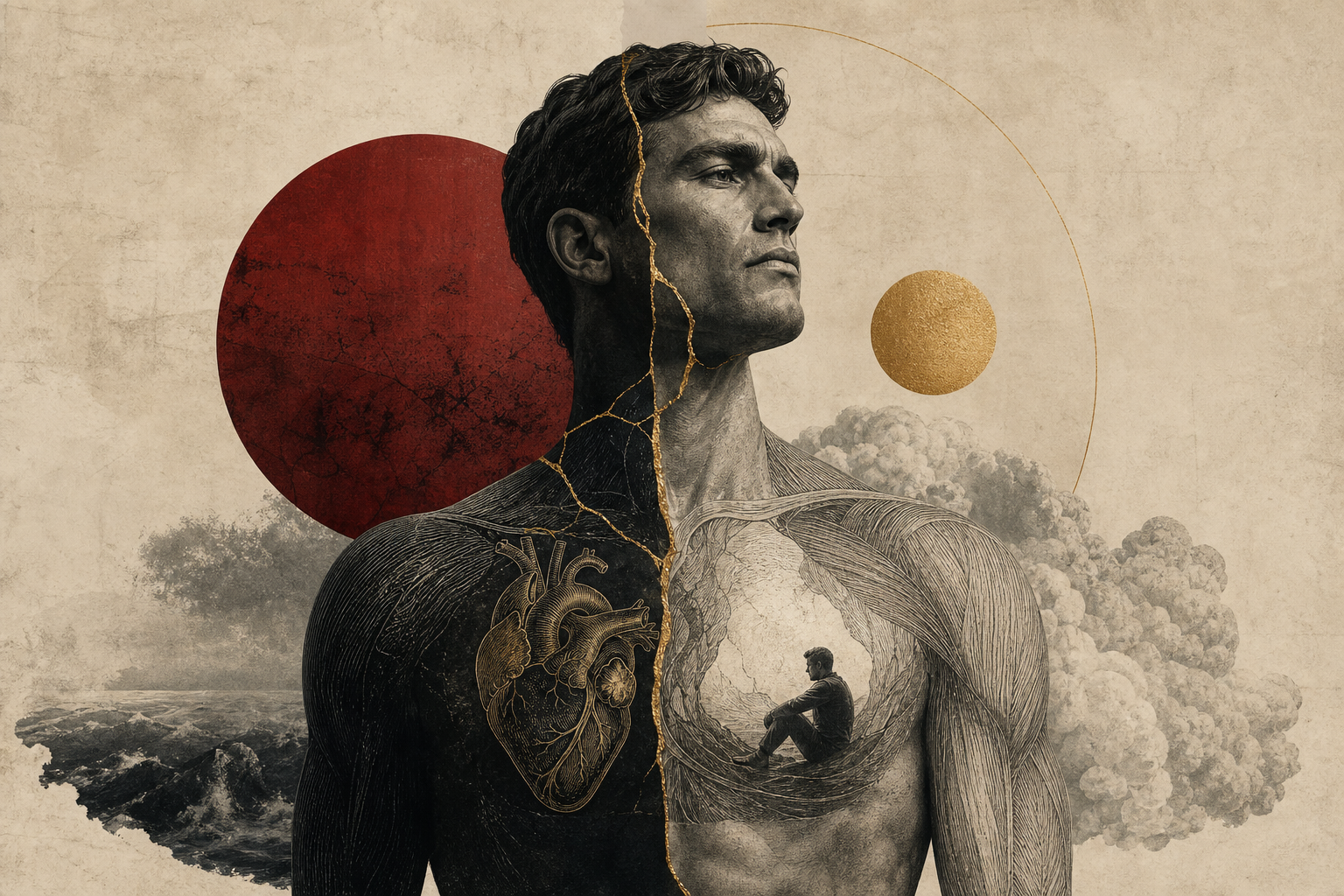
The standard advice for men in crisis is often a paradox that feels impossible to execute. We are told to be strong, yet we are also told that suppressing our emotions is a primary driver of anxiety, depression, and relationship failure. The result is a modern identity crisis: men feel pressured to be unshakeable pillars, yet they are terrified that showing a crack in the foundation means they have failed. This is not a call for a new, fragile masculinity; it is a call for a more integrated one. It is the distinction between being a rigid rod that snaps under pressure and being a flexible cable that can bear heavy loads without breaking. This is not about becoming a different person; it is about accessing the full spectrum of your own humanity so that you can function effectively in the real world, where the demands on you are rarely one-dimensional.
To understand why this integration is so difficult, we must look at how we are socialized to handle the male experience. In many cultures, masculinity is constructed around a binary of competence and control. You are expected to be the provider, the protector, and the problem-solver. If you feel fear, you are expected to act anyway. If you feel sadness, you are expected to move on. This is a survival mechanism, not a personality trait, but when it becomes a rigid identity, it creates a vacuum. The emotions do not disappear; they go underground. They manifest as physical tension, irritability, or a sudden, disproportionate rage that feels out of character. The man who believes he is 'strong' because he never cries is often the man who is most easily destabilized by a single event that bypasses his intellectual defenses.
The psychological literature supports the idea that emotional suppression is a costly strategy. While short-term suppression can help a person function in high-stakes environments, the broader research on emotion regulation suggests that chronic suppression is associated with increased physiological stress and poorer mental health outcomes. This is not a claim that men are 'broken' by their emotions, but rather that they are under-utilizing their own cognitive resources. By refusing to process the emotional data coming from their bodies and minds, men are forced to rely on a narrower set of coping mechanisms. This is where the concept of 'psychological flexibility' becomes essential. It is the ability to stay present with difficult emotions without being controlled by them. It is the difference between being flooded by a wave and learning to swim in it. A man who can feel fear and still make a clear decision is not less strong than a man who denies fear; he is more adaptable.
This is where the research on servant leadership offers a powerful, often overlooked, model for masculine strength. In a 2018 systematic review published in The Leadership Quarterly, researchers including Nathan Eva and Robert C. Liden examined the concept of servant leadership. This framework, which prioritizes the well-being and development of others, challenges the traditional 'command and control' model of male authority. The review suggests that leaders who demonstrate empathy, humility, and a commitment to serving their teams are often more effective and less prone to burnout. This is a critical insight for men in any role—father, partner, manager, or friend. Strength is not just about imposing your will; it is about having the confidence to serve. It is the ability to say, 'I see your need, and I am willing to help you meet it,' without feeling that you are losing your power. This is a form of strength that requires a high degree of self-awareness and emotional regulation.
However, a serious counterargument must be addressed: the fear that integrating vulnerability will make a man 'soft' or less desirable. This concern is not without merit, but it relies on a flawed premise. It assumes that strength and vulnerability are mutually exclusive, that one must be sacrificed for the other. In reality, they are complementary. A man who can express his needs, his fears, and his limits is not a weaker man; he is a more honest one. Honesty is a form of power because it reduces the cognitive load of maintaining a false persona. It also builds trust, which is the foundation of any durable relationship. The man who is always 'strong' is often isolated because he cannot share the burden of his life. The man who can be vulnerable is not asking for pity; he is offering a more accurate picture of himself, which allows others to connect with him on a deeper level. This is not a concession to a cultural trend; it is a practical strategy for building a life that is both resilient and meaningful.
The practical application of this integrated masculinity begins with a shift in how we define our own success. Instead of measuring success by our ability to endure pressure without complaint, we should measure it by our ability to navigate complexity with clarity. This means developing a 'vocabulary' for our internal states. When you feel a surge of anger, instead of immediately acting on it or suppressing it, you can pause and ask, 'What is this anger protecting? Is it fear? Is it a boundary being crossed?' This is not introspection for its own sake; it is a diagnostic tool. It allows you to identify the root cause of your distress and choose a response that is aligned with your values, rather than one that is dictated by your immediate emotional state. This is the essence of psychological flexibility: the ability to choose your response, rather than being a slave to your reaction.
This approach also has profound implications for how we handle conflict. In many relationships, conflict is a battleground where each person tries to 'win' by asserting their dominance. This is a low-trust, high-stress dynamic that erodes the relationship over time. An integrated masculine approach to conflict is different. It is not about conceding your position; it is about understanding the other person's position. It is about asking, 'What is your fear? What is your need?' This is not a passive strategy; it is an active one. It requires you to hold your own ground while simultaneously making space for the other person's reality. This is a more difficult skill than simple dominance, but it is a more effective one. It allows you to resolve conflict without damaging the relationship, and it builds a reservoir of trust that can be drawn upon in times of greater crisis. This is the kind of strength that is sustainable, because it is not based on the suppression of the other person, but on the integration of both.
We must also consider the role of culture in shaping our expectations of masculinity. The 2010 meta-analytic review by Vas Taras and colleagues in the Journal of Applied Psychology examined the cross-cultural validity and predictive power of Hofstede's cultural value dimensions. Their findings suggest that dimensions such as individualism versus collectivism shape the behavioral and attitudinal patterns people develop within their cultural context. In cultures that value individualism, the pressure to be self-reliant and emotionally self-sufficient is often higher. In cultures that value collectivism, the emphasis on group harmony and mutual support creates a different set of expectations. Understanding these cultural influences is not an excuse for rigid behavior; it is a way to contextualize your own patterns. It allows you to see that your way of handling stress is not a universal truth, but a product of your environment. This realization can be liberating, because it opens the door to exploring new ways of being that are more aligned with your personal values.
The integration of strength and vulnerability is not a one-time achievement; it is a continuous practice. It requires you to be honest with yourself about your limitations and your needs, to seek out relationships built on mutual respect and emotional safety, and to be willing to change your behavior when it is no longer serving you. There will be moments when you feel vulnerable and exposed, and moments when you feel strong and confident. The key is to not let either state define you. You are not your worst moment, and you are not your best one. You are the process of integrating them.
As you reflect on your own approach to strength and vulnerability, consider what changes you are willing to make. What is one area of your life where you are currently suppressing your emotions? What is one relationship where you could offer more honesty? These are not small questions, but they are the beginning of a larger shift. The goal is not to be perfect, but to be whole. And in that wholeness, you will find a strength that is far more powerful than any rigid performance of masculinity.
Discussion
No approved comments yet. You can start the conversation.