
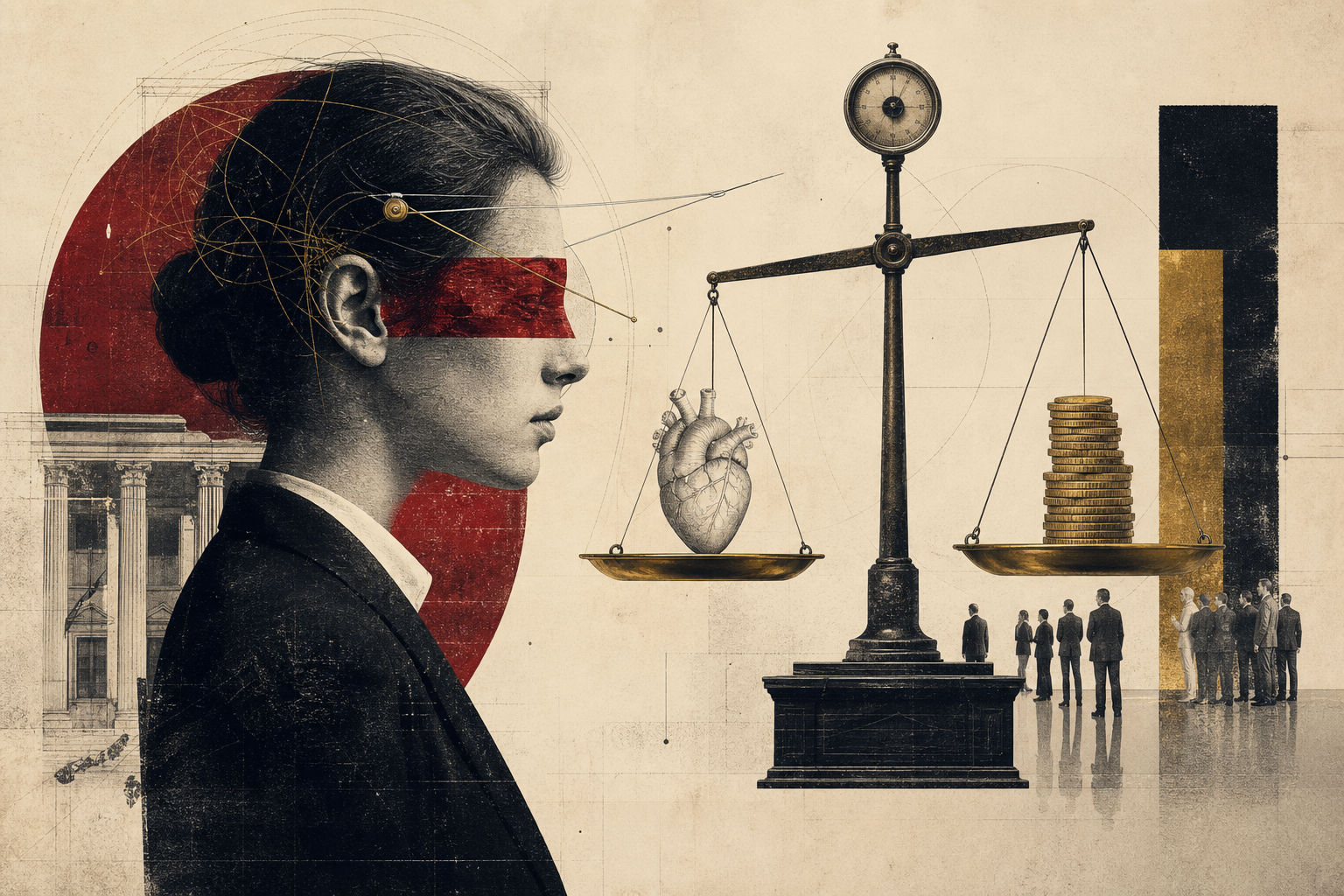
In a mid-sized corporate law firm, a senior partner tells a junior associate that the firm's core value is 'integrity.' Yet the annual compensation review is calculated exclusively on billable hours and client retention. When the junior associate spends a week pro bono on a housing rights case that aligns with the firm's public mission, the senior partner praises her publicly but notes privately that her 'revenue per head' has dropped. The system did not punish her for lacking integrity; it simply rewarded her for generating cash. The integrity was a decorative sign; the hours were the currency. This disconnect is not a conspiracy, nor is it always malicious. It is the predictable result of a system where the metric for success is decoupled from the metric for virtue.
Human beings are exceptionally good at navigating the incentives they face, even when those incentives conflict with their stated values. This is not a failure of character, but a feature of cognitive economy. We are wired to optimize for survival and status, and in complex social environments, the path of least resistance is often the path of highest reward. When a system rewards speed over accuracy, or silence over dissent, or conformity over nuance, most rational agents will drift toward the rewarded behavior, regardless of their initial intentions. To understand why people behave as they do, we must stop asking 'Who is bad?' and start asking 'What is the system paying for?'
The economic framework for this is straightforward. Incentives are the levers of behavior. If you want to change behavior, you must change the incentive structure. However, the design of these structures is rarely transparent. They are embedded in performance reviews, promotion criteria, social norms, and peer pressure. Venkatesh and Bala's Technology Acceptance Model 3 (TAM3) was built to explain why people adopt or reject technology, but its core insight applies more broadly: perceived usefulness and perceived ease of use drive adoption decisions. In social and professional contexts, 'perceived usefulness' is often defined by the tangible rewards the system offers. If speaking up is perceived as risky (low utility) and staying silent is safe (high utility), silence becomes the rational choice, even for the most principled individuals.
Consider the medical field, where the pressure to reduce wait times and increase throughput often clashes with the need for thorough patient care. A doctor who takes an extra ten minutes with every patient to ensure they truly understand their diagnosis is often viewed as 'inefficient' by administrators who measure success by patient volume. The doctor's integrity is real, but the system's reward structure for speed creates a persistent tension. When the doctor eventually cuts corners, it is not because they have become a bad doctor; it is because the system has made thoroughness a costly deviation from the norm. The blame for the resulting errors often falls on the individual, but the root cause is the misalignment between the desired outcome (patient safety) and the rewarded behavior (throughput).
This dynamic is pervasive in academia as well. The 'publish or perish' culture rewards quantity over quality, and novelty over replication. The Open Science Collaboration's 2015 study on the reproducibility of psychological science found that roughly 63 to 69 percent of published effects could be replicated, depending on the criterion used, and that the median effect size in replications was about half the original. That means a substantial minority of published findings do not hold up under independent testing. This is not because scientists are liars, but because the incentive structure rewards the publication of novel, positive results. Negative results are less likely to be published, and replication studies are often seen as unglamorous. Button and colleagues made a related point in neuroscience: small sample sizes, which are common in the field, systematically inflate effect sizes and undermine the reliability of findings. The system is designed to produce a body of knowledge that looks more robust than it actually is, because the costs of producing robust knowledge (time, resources, lack of career advancement) are not adequately compensated.
A common counterargument is that individuals are still responsible for their actions, and that blaming the system is a way to avoid accountability. This is a valid point. People are moral agents, and they can choose to act against incentives. However, this view underestimates the power of structural pressure. When everyone in a room is incentivized to do X, the social cost of doing Y is extremely high. It is not just that the individual is being punished for doing Y; it is that they are being isolated, questioned, and marginalized. The incentive to belong and to avoid social risk is powerful. To expect individuals to consistently override these pressures without changing the system is to set a standard that is practically impossible for most people to meet.
Furthermore, the assumption that individuals are the primary drivers of behavior ignores the role of cognitive bias and limited information. We are not rational calculators who weigh all pros and cons before acting. We are heuristics-driven creatures who rely on cues from our environment. When the environment signals that a certain behavior is rewarded, we internalize that signal. This is not a moral failing; it is a learning process. We learn what works by observing the outcomes of others' actions. If the people around us are rewarded for a certain behavior, we are likely to adopt that behavior, even if we initially disagreed with it. This is how norms are formed and how cultures evolve.
The implications for policy and institutional design are significant. If we want to change behavior, we must change the incentives. This is easier said than done, because the incentive structures are often complex and intertwined with other values. Imbens and Wooldridge's work on the econometrics of program evaluation highlights a related problem: even when we try to measure whether an intervention works, the methods we use can obscure the true causal effect if we do not carefully account for selection and confounding. In the legal system, for example, the incentive to convict is often stronger than the incentive to acquit, because a conviction is seen as a success for the prosecutor, while an acquittal is seen as a failure. This creates a bias toward conviction, even when the evidence is ambiguous. The solution is not to tell prosecutors to be more careful, but to change the way success is measured. If prosecutors are rewarded for accuracy rather than conviction rates, the behavior will change.
Nilsén's work on implementation science adds another layer: even when the right intervention is identified, the process of putting it into practice is shaped by the local context, the capacity of the people involved, and the incentives they face. A policy that works in one setting may fail in another not because the idea is wrong, but because the incentive structure surrounding it is different. This is why 'just change the incentive' is a simplification. The incentive is one node in a network of pressures, norms, and constraints that must be understood together.
It is important to be clear about what this means. It does not mean that individuals are not responsible for their actions. It does not mean that we should excuse bad behavior. It does mean that we should be skeptical of explanations that focus solely on individual character. When we see a pattern of bad behavior, we should ask what incentives are driving it. This is a more productive question than asking who is to blame, because it points to a solution. If we can identify the incentives, we can change them. If we cannot identify the incentives, we are likely to miss the root cause of the problem.
In the end, the question is not 'Who is bad?' but 'What is the system rewarding?' This is a shift in perspective that can help us understand the world around us more clearly. It can help us design better systems, hold ourselves and others more accountable, and create a more just society. It is a challenging perspective, because it requires us to look beyond our own intentions and to consider the broader context in which we operate. But it is a necessary perspective, because it is the only one that can lead to real change.
To apply this insight, start by looking at your own life. What are the incentives in your work, your relationships, and your community? What behavior are they rewarding? Is that the behavior you want? If not, what can you do to change the incentives? This is a practical question, and it is one that you can answer for yourself. By focusing on the incentives, you can start to change the behavior, and in doing so, you can create a better world for yourself and for others.
The challenge is that incentives are often hidden. They are not always explicit, and they are not always easy to identify. But they are there, and they are powerful. By learning to see them, you can start to understand the behavior around you, and you can start to change it. This is the power of watching what the system rewards. It is a simple idea, but it has profound implications. It is a reminder that we are not just individuals, but part of a system, and that the system shapes us as much as we shape it.
Discussion
No approved comments yet. You can start the conversation.