
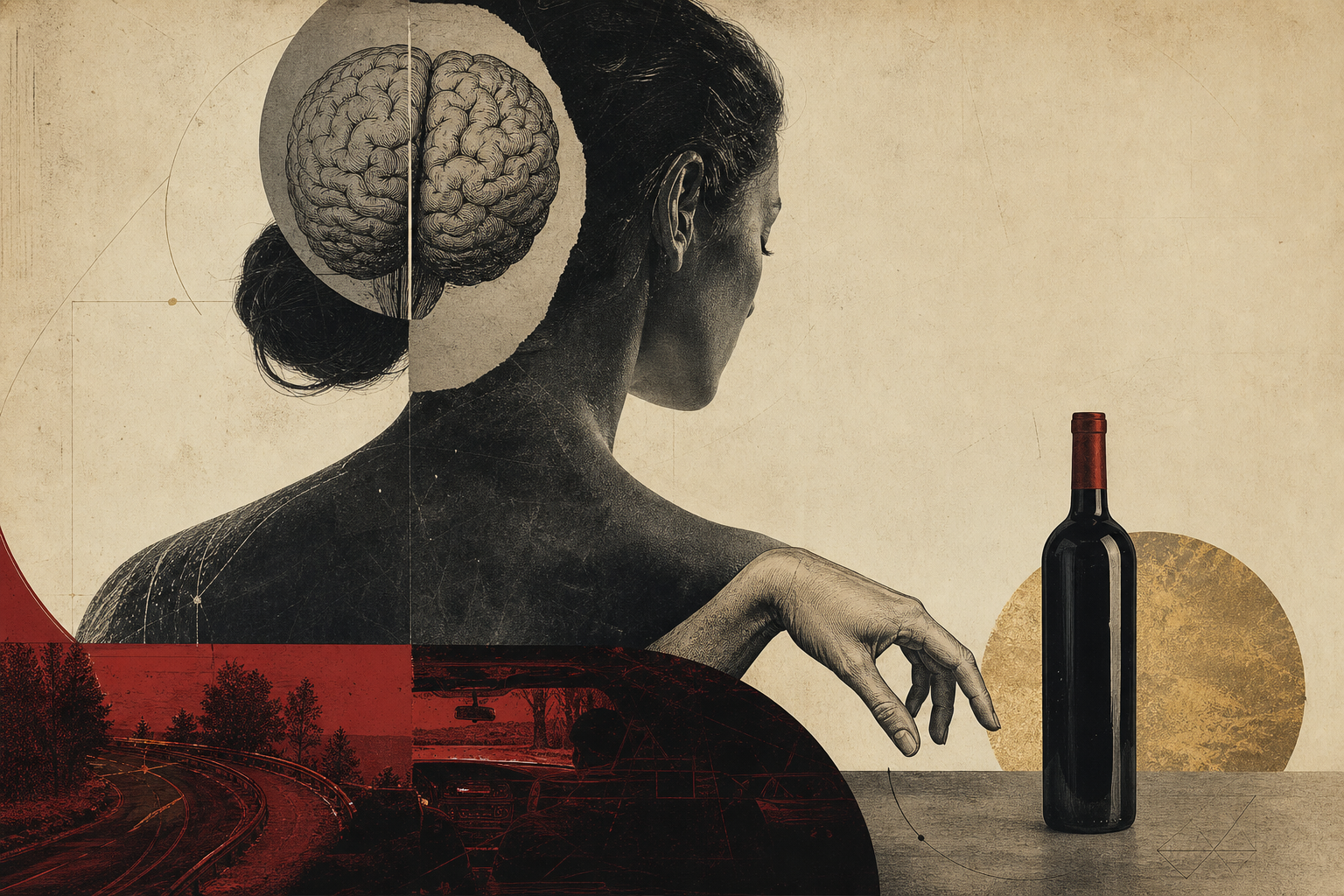
You told your partner last Tuesday that you were fine, that you didn't need anything, that the argument was over. Then you drove to the grocery store, bought the exact wine you'd been wanting for three weeks, and sat in the parking lot for eleven minutes before going inside. You didn't plan that. You didn't feel that. But your hands did it, and your hands have been doing it for a long time, and the wine in the trunk is a more accurate report of your state than the sentence you spoke.
This is not a metaphor. It is a description of how a significant portion of human behavior actually works. The psychologists Wendy Wood and Dennis Rünger, in their comprehensive review of the habit literature, describe a system in which much of what we do is driven by context-triggered routines that operate with minimal conscious deliberation. You do not decide to reach for your phone the moment you sit down. You do not evaluate, weigh, and choose the route you drive to work every morning. These are not failures of willpower. They are the architecture of how the brain conserves effort. The implication for self-knowledge is uncomfortable: a substantial share of your behavior is generated by processes you are not, at the moment of action, actively running.
Now consider what introspection actually gives you. Jonathan Smallwood and Jonathan Schooler, reviewing the mind-wandering literature, describe a consciousness that is not the steady, transparent window we assume. Attention drifts. The stream of thought is fragmented, self-referential, and frequently unmoored from the present task. When you ask yourself why you are angry, or why you keep choosing the same kind of partner, or why you said the thing you said, you are not reading a log file. You are generating a narrative in real time, using whatever fragments are available, filling gaps with plausible story, and then experiencing the finished product as if it were a memory. That reconstruction is an inference from the mind-wandering data, not a finding the papers state in those terms, but it follows from what the evidence shows about how attention and self-monitoring actually work.
This is where the gap between feeling and doing becomes structurally inevitable, not merely a matter of dishonesty. You can genuinely feel that you value honesty, and then lie to your friend about how much you enjoyed their dinner. You can feel that you want to be more present with your children, and then check your phone forty-seven times during a school play. The feeling is real. The behavior is also real. They are not the same signal, and the behavior is generated by a system that the feeling does not have access to. Wood and Rünger's work makes this concrete: habitual action is triggered by context, executed with minimal conscious deliberation, and reinforced by outcomes that may not be explicitly tracked by the person performing them. Your stated values and your actual routines are running on different operating systems.
There is a counterargument worth taking seriously. Some people have trained their introspective capacity to a degree that most have not. Meditation practitioners, therapists, and certain kinds of reflective writers can report on their inner states with a granularity and accuracy that the average person cannot. But even here the evidence is more complicated than the popular narrative suggests. Nicholas Van Dam and colleagues, in a critical review of the mindfulness and meditation literature, point out that measuring the internal states that meditation supposedly produces is far harder than assumed. The very phenomenon under investigation is private, transient, and difficult to operationalize without circularity. If even the people who have spent years cultivating a particular kind of self-observation struggle to verify what they are experiencing, the assumption that the untrained mind is a reliable instrument is not just optimistic. It is unsupported.
The clinical literature sharpens the point further. Diego Pizzagalli's work on frontocingulate dysfunction in depression shows that the brain systems responsible for evaluating reward, making decisions, and generating subjective experience can be altered in ways that compromise the accuracy of a person's own self-report. A person in a depressive episode may minimize their distress, or may experience a pervasive negative self-evaluation that colors every judgment, and both reports are unreliable not because of deception but because the neural machinery that generates the report is itself altered. If your internal narrative can be distorted by a mood disorder, it can be distorted by a bad night's sleep, a hormonal shift, a social comparison you have not noticed, or a habit loop that has been running for years without your explicit awareness.
So what is the practical framework? It is not that you should stop introspecting. It is that you should treat introspection as one channel of evidence, not the primary one, and weight it accordingly. The more reliable signal is the pattern of repeated choices under conditions where you are not performing. What do you buy when no one is watching? What do you do on a Saturday morning when you have no obligations? What do you forgive quickly and what do you hold for years? What do you do when you are tired, bored, or slightly drunk? These are not moral tests. They are data points from a system that is running whether or not you are narrating it.
A concrete exercise: for one week, keep a log of three things. First, what you said you would do. Second, what you actually did. Third, the gap between them, and the context in which the gap appeared. Do not judge the gap. Do not explain it away. Just record it. At the end of the week, look for the pattern. The pattern is the evidence. Your feelings about the pattern are a secondary signal, useful but not primary. This is not a trick. It is a shift in epistemic hierarchy: you are no longer the sole author of your self-knowledge. Your behavior is a co-author, and it has been writing all along.
The strongest counterargument to this whole framework is that behavior is also noisy, context-dependent, and shaped by constraints that have nothing to do with values. A person who never volunteers may not be selfish; they may have no free time, no community infrastructure, or a history of being exploited by organizations. A person who cheats on their partner may not be the person their self-report suggests; they may be in a relationship that has been slowly eroding their sense of self for years. Behavior is more reliable than introspection, but it is not infallible. The honest position is that both channels are partial, and the task is to triangulate rather than to worship either one.
This is where the intellectual tradition of self-knowledge gets its real difficulty. Socrates said know thyself, and the instruction was not to sit in a room and think. It was to examine your actions, your choices, your responses to other people, your responses to difficulty. The Greek tradition understood that the self is revealed in the doing, not in the saying. What has changed in the modern period is that we have built an entire cultural infrastructure around the primacy of the felt experience: the journal, the therapy session, the social media confession, the podcast where someone tells you their truth. None of these are worthless. But they are all downstream of the behavioral record, and they are all subject to the reconstruction problem described above.
The constructive path is not to abandon introspection but to subordinate it to evidence. Ask yourself what you actually do, not just what you feel. Look at the repeated choices, the patterns that survive contact with time. Treat your internal narrative as a hypothesis to be tested against your behavior, not as a conclusion to be defended. When the two disagree, as they will, the disagreement is the most valuable information you have about yourself. It is where the real work begins.
You are not a broken instrument. You are a complex system with multiple channels of self-knowledge, and you have been relying on the least reliable one because it is the most accessible. That is understandable. But the wine in the trunk knows something your Tuesday-morning self did not. Listen to it.
Discussion
No approved comments yet. You can start the conversation.